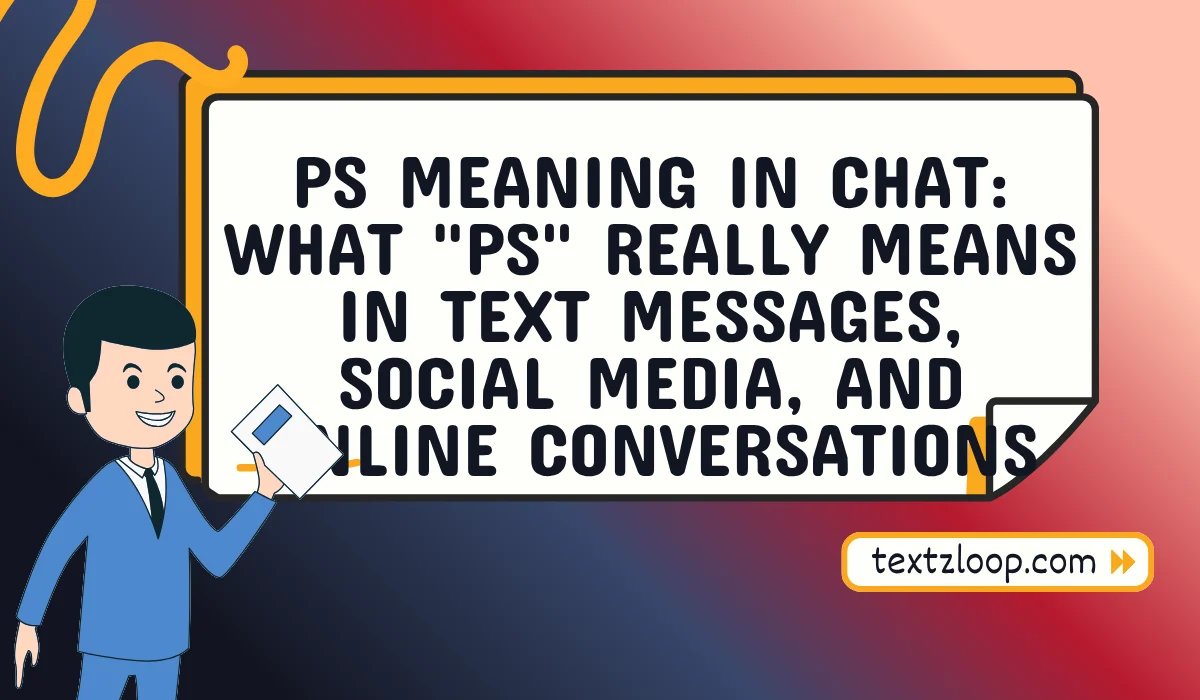
If you’ve ever received a message ending with “PS” and wondered what it means, you’re not alone. Whether you’re chatting on WhatsApp, scrolling through Instagram DMs, reading comments on TikTok, or exchanging emails, the abbreviation PS appears surprisingly often.
Many people associate PS with formal letters from school or business communication. However, in today’s digital world, its meaning has expanded beyond traditional writing. That’s why so many users search for “PS meaning in chat”—to understand whether it’s casual, serious, romantic, or simply an afterthought.
The good news is that PS is usually simple to understand once you know the context. In this guide, you’ll learn what PS means, where it came from, how people use it online, and what it can reveal about communication styles and emotions.
PS Meaning in Chat – Quick Meaning
In chat and messaging, PS stands for “Postscript”, which literally means “written after.”
People use PS when they want to add an extra thought, reminder, joke, or important detail after they’ve already finished their main message.
Simple Definition
PS = An additional message or thought added after the main conversation or statement.
Quick Examples
- “I’ll send you the files tonight. PS: Don’t forget tomorrow’s meeting.“
- “Happy birthday! PS: I still owe you a gift.“
- “Your outfit looked amazing. PS: The shoes were my favorite part.“
Key Characteristics
- Adds extra information
- Often feels personal or informal
- Can emphasize emotions or humor
- Common in texts, emails, and social media messages
Origin and Background of PS
The abbreviation PS comes from the Latin phrase “post scriptum,” which translates to “written after.”
Before computers and smartphones existed, people wrote letters by hand. If they forgot to include important information after signing their letter, they would add a postscript beneath their signature using “P.S.”
For example:
Dear Sarah,
Thank you for visiting last week.
Best wishes,
JohnP.S. Please send me your new address.
Over time, PS became more than just a correction or forgotten note. Writers started using it strategically because readers naturally pay attention to information placed at the end.
Today, PS has evolved into a popular communication tool across:
- Text messaging
- WhatsApp chats
- Instagram DMs
- TikTok comments
- Emails
- Social media captions
- Online communities
What began as a practical writing habit has become part of modern digital culture.
Real-Life Conversations Using PS
WhatsApp Conversation
Person A: Hey, are we still meeting at 7?
Person B: Yes, absolutely. I’ll be there around 6:50.
PS: I booked our favorite table.
Person A: That’s awesome. Thanks!
Instagram DM Conversation
Person A: Your travel photos look incredible.
Person B: Thank you! That trip was unforgettable.
**PS: The sunset pictures weren’t even edited.
Person A: No way! They looked professional.
Text Message Conversation
Person A: Good luck with your presentation tomorrow.
Person B: Thanks so much. I’ve been preparing all week.
**PS: I’m honestly still nervous.
Person A: You’ll do great. Trust yourself.
TikTok Comment Example
User 1: This recipe actually worked!
User 2: Same here.
**PS: I accidentally doubled the chocolate, and it was even better.
Emotional and Psychological Meaning of PS
Interestingly, PS often communicates more than just additional information.
In everyday conversations, people use PS because it feels more personal, spontaneous, and emotionally honest. A postscript can reveal thoughts that someone didn’t initially intend to share.
PS Often Reflects:
Emotional Honesty
People frequently use PS when expressing feelings they were hesitant to mention.
Example:
“Good night. PS: I really missed talking to you today.”
Playfulness
Adding a PS can make messages feel more conversational and humorous.
Example:
“I’ll see you tomorrow. PS: Bring snacks.”
Vulnerability
Sometimes, PS allows people to share emotions with less pressure.
Example:
“I’m fine. PS: Actually, today was pretty difficult.”
Personal Connection
A PS often creates intimacy because it feels like a private afterthought rather than a formal statement.
This explains why marketers, writers, friends, and romantic partners all use PS differently but effectively.
Usage of PS in Different Contexts
PS on Social Media
On platforms like Instagram, TikTok, Facebook, and X, PS is commonly used to add personality or humor.
Examples:
- “New vlog is live! PS: The ending is hilarious.”
- “Vacation photos finally uploaded. PS: I already miss the beach.”
PS Between Friends
Friends often use PS casually.
Examples:
- “I’m coming over at 8. PS: Order pizza.”
- “Happy birthday! PS: You’re getting old.”
PS in Relationships
In romantic conversations, PS can add warmth and affection.
Examples:
- “Drive safely. PS: I love you.”
- “Good night. PS: I wish you were here.”
PS in Professional Communication
In work settings, PS should be used carefully.
Examples:
- “Please review the attached report. PS: Thank you for your quick response.”
Professional use is usually acceptable in:
- Emails
- Newsletters
- Marketing messages
However, it should remain respectful and concise.
Casual vs Serious Usage
| Context | Appropriate? | Tone |
|---|---|---|
| Text messages | Yes | Casual |
| Yes | Friendly | |
| Yes | Informal | |
| TikTok | Yes | Playful |
| Business emails | Sometimes | Professional |
| Legal documents | No | Too informal |
Common Misunderstandings About PS
Many people misunderstand how PS works in digital communication.
Mistake #1: Thinking PS Has a Hidden Meaning
In most situations, PS simply means an extra thought. It rarely contains secret messages.
Mistake #2: Assuming It’s Always Romantic
While couples often use PS affectionately, friends, coworkers, and brands use it too.
Mistake #3: Using Multiple PS Notes Excessively
Example:
- PS
- PPS
- PPPS
- PPPPS
Although technically correct, too many postscripts can look unprofessional or confusing.
Mistake #4: Using PS in Formal Legal Communication
Formal documents typically avoid PS because information should appear within the main text.
PS Compared to Similar Terms
| Term | Meaning | Usage | Opposite/Related |
|---|---|---|---|
| PS | Additional thought | Text and writing | Main message |
| BTW | By the way | Casual conversation | Direct statement |
| FYI | For your information | Informational | Personal opinion |
| NB | Important note | Formal writing | Casual remark |
| Edit | Correction/addition | Social media | Original post |
| TL;DR | Summary | Long content | Detailed explanation |
Key Insight
Unlike abbreviations such as BTW or FYI, PS creates a feeling of personal emphasis. It often feels more intimate and memorable because it appears after the main message has already ended.
Variations and Types of PS Usage
1. Friendly PS
Adds warmth to casual conversations.
Example:
“See you tonight. PS: Bring your camera.”
2. Romantic PS
Expresses affection.
Example:
“Sleep well. PS: Thinking about you.”
3. Funny PS
Adds humor.
Example:
“I finished the assignment. PS: Barely survived.”
4. Reminder PS
Highlights important information.
Example:
“Meeting starts at 10. PS: Don’t be late.”
5. Confessional PS
Shares hidden feelings.
Example:
“Everything’s okay. PS: I’m actually stressed.”
6. Marketing PS
Encourages action.
Example:
“Limited offer ends tonight. PS: Only three spots remain.”
7. Social Media PS
Adds personality.
Example:
“Photo dump complete. PS: Swipe to the last picture.”
8. Professional PS
Provides a final note.
Example:
“Thank you for your consideration. PS: References are available.”
9. Appreciation PS
Shows gratitude.
Example:
“Thanks for helping. PS: I truly appreciate it.”
10. Surprise PS
Introduces unexpected information.
Example:
“I have exciting news. PS: I got the job.”
How to Respond When Someone Uses PS
Casual Responses
- “Good reminder.”
- “Haha, thanks.”
- “I’ll remember that.”
- “That’s true.”
Funny Responses
- “The PS was better than the original message.”
- “You saved the best part for last.”
- “Plot twist unlocked.”
Mature and Confident Responses
- “Thanks for adding that.”
- “I appreciate your honesty.”
- “That’s helpful to know.”
Private or Respectful Responses
- “Thank you for sharing that.”
- “I understand how you feel.”
- “I’m glad you mentioned it.”
Regional and Cultural Usage
Western Culture
In North America and Europe, PS is widely recognized and commonly used in:
- Text messages
- Emails
- Marketing
- Social media
People often view it as friendly and conversational.
Asian Culture
In many Asian countries, PS is more commonly associated with:
- Academic writing
- Formal communication
- Business emails
However, younger generations increasingly use it casually online.
Middle Eastern Culture
In Middle Eastern digital communication, PS is typically used among:
- Friends
- Family members
- Social media communities
It often adds emotional warmth and personal connection.
Global Internet Culture
Across global internet communities, PS has become a universal expression for:
- Extra thoughts
- Humor
- Personal emotions
- Final reminders
- Hidden opinions
Its meaning remains remarkably consistent worldwide.
Frequently Asked Questions
What does PS mean in chat?
PS means “Postscript,” which refers to an additional message added after the main statement.
Is PS rude in texting?
No. PS is generally considered friendly, casual, and helpful.
Can PS be romantic?
Yes. Many people use PS to express affection or personal feelings.
What is the difference between PS and BTW?
PS adds an afterthought after the main message, while BTW introduces information during the conversation.
Is PS professional?
It can be professional in emails and marketing but should be used sparingly.
Why do people use PS online?
People use PS to emphasize information, express emotions, add humor, or share personal thoughts.
Can I use PS on social media?
Absolutely. PS is commonly used on Instagram, TikTok, Facebook, and messaging apps.
Conclusion
Understanding the PS meaning in chat is easier once you recognize its purpose: it’s simply an additional thought shared after the main message.
Although PS originated centuries ago in handwritten letters, it remains surprisingly relevant in today’s digital world. From WhatsApp chats and Instagram DMs to professional emails and social media captions, PS helps people communicate emotions, humor, reminders, and personal insights more naturally.
What makes PS special isn’t just its definition—it’s the human connection behind it. Sometimes the most meaningful part of a conversation isn’t what we say first, but what we decide to add afterward.
Discover more article
Chopped Meaning: What It Really Means in Slang, Texting, Social Media, and Everyday English
Based Urban Dictionary: Meaning, Origin, Examples, and How People Really Use It Today