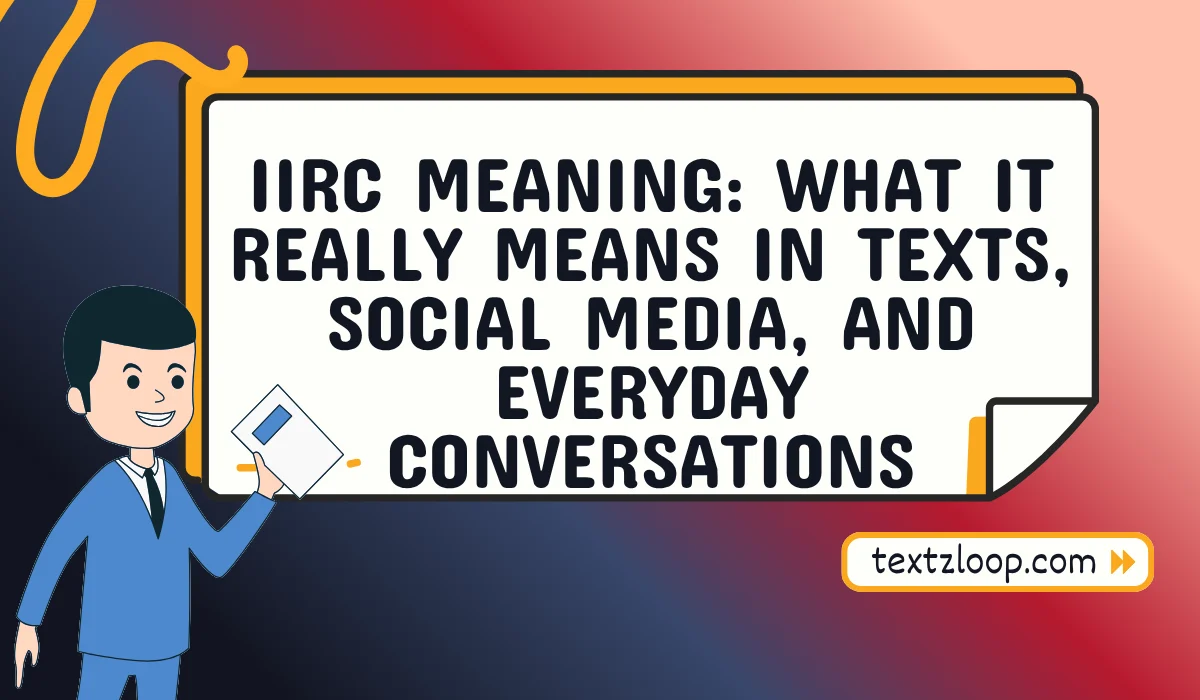
If you’ve ever received a message saying, “IIRC, the meeting starts at 3 PM,” you may have paused and wondered what exactly IIRC means.
This abbreviation appears frequently in text messages, online forums, social media discussions, gaming communities, and even casual workplace conversations. While many internet abbreviations disappear over time, IIRC has remained surprisingly popular because it expresses something people do every day: recalling information without claiming complete certainty.
People often search for “IIRC meaning” because they encounter it in chats, Reddit discussions, comment sections, or professional messages and want to understand both its literal meaning and the tone behind it.
In this guide, you’ll learn what IIRC means, where it came from, how people actually use it in real life, and when you should—or shouldn’t—use it yourself.
IIRC Meaning – Quick Definition
IIRC stands for: “If I Recall Correctly” or “If I Remember Correctly.”
It is used when someone believes they remember information accurately but wants to acknowledge that they could be mistaken.
Simple Definition:
IIRC = “I’m pretty sure this is correct, but I’m not 100% certain.”
Quick Examples:
- “IIRC, the restaurant closes at 10 PM.”
- “IIRC, we met at Sarah’s birthday party.”
- “IIRC, that movie came out around 2019.”
Key Characteristics:
- Shows uncertainty politely
- Sounds conversational and humble
- Common in texting and online discussions
- Helps avoid sounding overly confident
Origin and Background of IIRC
The abbreviation IIRC became popular during the early years of internet communication, particularly in online forums, chat rooms, bulletin board systems (BBS), and email communities during the 1980s and 1990s.
Back then, internet users relied heavily on abbreviations because typing was slower and platforms often had character limitations. Similar abbreviations such as:
- IMO (In My Opinion)
- IMHO (In My Humble Opinion)
- FYI (For Your Information)
- BRB (Be Right Back)
also gained popularity during this period.
Unlike some internet slang that originated among teenagers, IIRC became widely used by adults participating in discussion boards, technology forums, and academic communities. This helped the phrase maintain a more mature and professional reputation than many other online abbreviations.
Today, IIRC remains popular because it serves an important social function: expressing confidence while remaining open to correction.
Real-Life Conversations Using IIRC
Below are realistic examples of how people naturally use IIRC in everyday communication.
WhatsApp Conversation
Person A: Do you remember what time the dentist appointment is tomorrow?
Person B: IIRC, it’s around 11:30 AM, but check the reminder text just to be safe.
Instagram DMs
Person A: Wasn’t that café we visited in Barcelona near the beach?
Person B: Yeah, IIRC, it was about a five-minute walk from the waterfront.
TikTok Comments
Person A: Didn’t this song originally trend back in 2021?
Person B: IIRC, it actually started getting popular in late 2020.
Text Message Conversation
Person A: Which professor teaches Economics 101?
Person B: IIRC, it’s Professor Williams this semester.
The Emotional and Psychological Meaning Behind IIRC
At first glance, IIRC seems like a simple abbreviation. But psychologically, it communicates something deeper.
When people use IIRC, they’re often trying to balance two competing social goals:
1. Sharing Information
People want to contribute useful information or participate in a conversation.
2. Avoiding Overconfidence
At the same time, they don’t want to appear arrogant or spread misinformation if their memory isn’t perfect.
This creates a communication style that feels:
- Humble
- Cooperative
- Honest
- Respectful
- Self-aware
In many ways, using IIRC reflects modern communication habits, where people increasingly prefer acknowledging uncertainty rather than pretending to know everything.
For example:
“IIRC, the policy changed last year.”
This statement sounds more trustworthy than:
“The policy definitely changed last year.”
because it honestly reflects the speaker’s level of certainty.
Using IIRC in Different Contexts
Social Media
IIRC is extremely common on platforms where people discuss facts, memories, trends, or opinions.
Examples:
- “IIRC, this meme originally came from Tumblr.”
- “IIRC, the actor won an award for this role.”
Friends and Relationships
Among friends, IIRC helps avoid unnecessary arguments over small details.
Example:
“IIRC, you said Friday worked better than Saturday.”
This sounds less confrontational than stating it as an absolute fact.
Workplace Communication
In professional environments, IIRC can be useful when discussing information from memory.
Example:
“IIRC, the client requested revisions by Thursday.”
However, it’s best used sparingly in formal business writing.
Casual vs. Serious Situations
| Situation | Appropriate? |
|---|---|
| Text messages | Yes |
| Social media | Yes |
| Online forums | Yes |
| Team chats | Usually |
| Academic papers | No |
| Legal documents | No |
| Official reports | No |
Common Misunderstandings About IIRC
Many people misunderstand how IIRC works.
Misunderstanding #1: It Means “I Know This for Sure”
Actually, IIRC indicates uncertainty, not certainty.
Misunderstanding #2: It’s Only Used by Young People
In reality, many long-time internet users and professionals use IIRC regularly.
Misunderstanding #3: It’s Unprofessional
While not suitable for formal documents, it’s often acceptable in workplace chats and informal emails.
Situations Where You Should Avoid Using IIRC
Avoid using IIRC when:
- Providing legal advice
- Giving medical information
- Writing academic research
- Creating official reports
- Delivering critical instructions
In these situations, verified information matters more than memory.
IIRC Compared With Similar Terms
| Term | Meaning | Confidence Level | Typical Usage |
|---|---|---|---|
| IIRC | If I Recall Correctly | Medium | Memory-based statements |
| IMO | In My Opinion | Personal opinion | Discussions and debates |
| IMHO | In My Humble Opinion | Personal opinion | Informal conversations |
| AFAIK | As Far As I Know | Moderate certainty | Knowledge sharing |
| TBH | To Be Honest | Personal honesty | Opinions and feelings |
| IDK | I Don’t Know | Low certainty | Uncertainty |
| Factually verified | Confirmed information | High certainty | Professional settings |
Key Insight
IIRC doesn’t claim expertise. Instead, it signals honest recollection while leaving room for correction, which often makes communication feel more trustworthy.
Variations and Related Expressions
Here are some common variations and related phrases connected to IIRC.
1. If I Remember Correctly
The full phrase from which IIRC originates.
2. If Memory Serves
A more formal alternative often used in writing.
3. As Far As I Remember
Expresses partial certainty.
4. AFAIK (As Far As I Know)
Focuses on knowledge rather than memory.
5. To The Best Of My Knowledge
A professional version of uncertainty.
6. I Think
A simple expression of uncertainty.
7. Maybe
Shows lower confidence.
8. If I’m Not Mistaken
A polite way to express probable accuracy.
9. From What I Recall
Often used in conversations and interviews.
10. I Believe
Indicates personal confidence without certainty.
How to Respond When Someone Uses IIRC
The best response depends on the context and your relationship with the person.
Casual Responses
- “Yeah, I think you’re right.”
- “That sounds familiar.”
- “Good memory!”
Funny Responses
- “We’ll trust your memory this time.”
- “Your brain is working better than mine.”
- “I’ll accept that expert recollection.”
Mature and Professional Responses
- “Thanks. I’ll verify that information.”
- “I appreciate the clarification.”
- “That aligns with what I remember.”
Private and Respectful Responses
- “I believe you’re correct.”
- “Let’s double-check just to be sure.”
- “Thanks for sharing your recollection.”
Regional and Cultural Usage
Although IIRC originated in English-speaking internet communities, its use has spread globally.
Western Culture
In North America and Europe, IIRC is widely understood among internet users and professionals who communicate online regularly.
People often use it to sound collaborative rather than authoritative.
Asian Culture
In many Asian online communities, English abbreviations like IIRC are commonly used by younger generations and international professionals.
However, full phrases may be preferred in formal settings.
Middle Eastern Culture
Among English-speaking internet users in the Middle East, IIRC appears frequently in social media discussions, gaming communities, and workplace chats.
Its use is generally associated with digital culture rather than regional language traditions.
Global Internet Usage
Today, IIRC has become part of global internet vocabulary, especially on platforms such as:
- Discord
- X (formerly Twitter)
- YouTube comments
- Online forums
- Gaming communities
- Messaging applications
Frequently Asked Questions
What does IIRC stand for?
IIRC stands for “If I Recall Correctly” or “If I Remember Correctly.”
Is IIRC rude?
No. IIRC is generally considered polite because it acknowledges uncertainty.
Is IIRC professional?
It can be appropriate in casual workplace communication but not in formal business documents.
Is IIRC still popular?
Yes. Although many internet abbreviations have faded, IIRC remains widely used in online conversations.
Can I use IIRC in text messages?
Absolutely. Text messaging is one of the most common places where IIRC appears.
What’s the difference between IIRC and AFAIK?
IIRC refers to memory, while AFAIK refers to knowledge or understanding.
Should I use IIRC in academic writing?
No. Academic writing requires verified information rather than personal recollection.
Conclusion
IIRC may be a short abbreviation, but it communicates something surprisingly important: intellectual honesty.
When someone says “IIRC,” they’re sharing information while admitting that human memory isn’t perfect. That small expression of uncertainty often makes communication feel more authentic, respectful, and trustworthy.
Whether you’re reading a text message, scrolling through social media, participating in an online discussion, or chatting with friends, understanding IIRC helps you interpret not only the words themselves but also the attitude behind them.
And if you decide to use it yourself, remember its real purpose: not to sound uncertain, but to sound honest.
Discover more article
Based Urban Dictionary: Meaning, Origin, Examples, and How People Really Use It Today