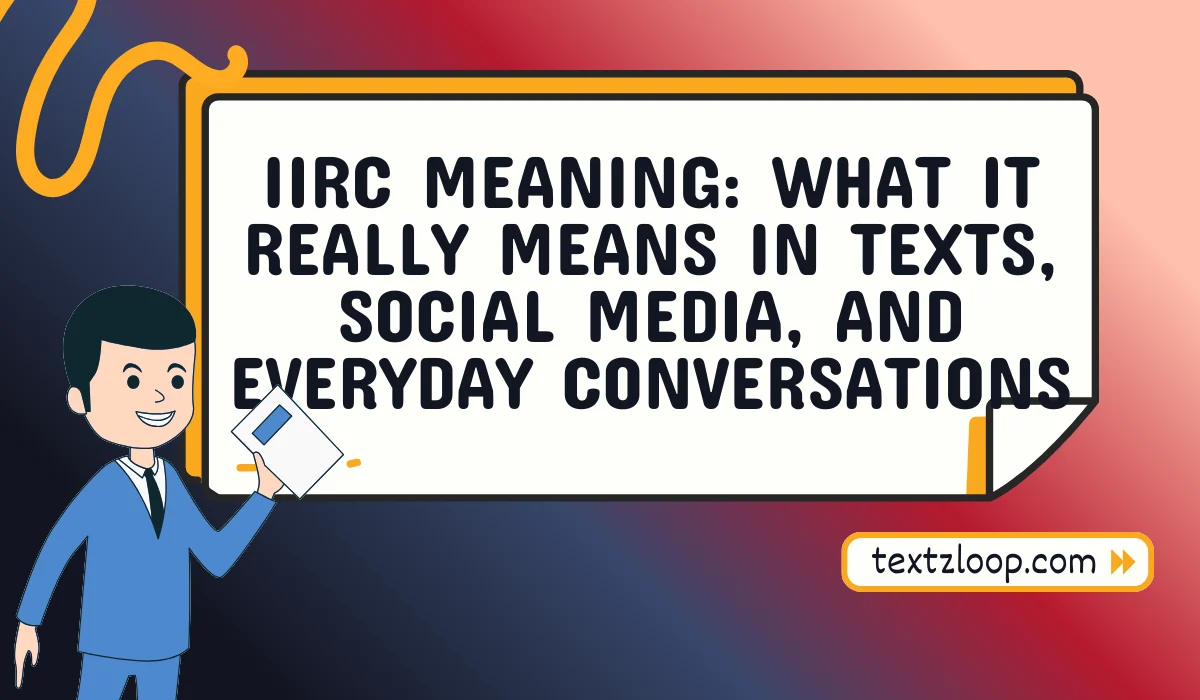
If you spend time on social media, texting friends, or reading online discussions, you’ve probably seen the abbreviation “IIRC.”
At first glance, it can feel confusing. Some people assume it’s a typo, while others think it’s a secret internet code.
In reality, IIRC is a simple shorthand used in everyday digital conversations. People use it when they’re not completely certain about something but still want to share what they remember.
Understanding this small abbreviation can help you read online discussions more clearly and communicate more naturally in chats, comments, and messages.
In this guide, we’ll explore the true meaning of IIRC, where it came from, how people use it in real conversations, and how you should respond when someone uses it.
IIRC – Quick Meaning
IIRC stands for:
“If I Remember Correctly.”
It’s used when someone recalls information but wants to signal they might not be 100% certain.
Simple Definition
- IIRC = “If I remember correctly”
- Used when recalling past information
- Shows uncertainty or humility
Quick Examples
“IIRC, the meeting starts at 3 PM.”
“IIRC, that restaurant closed last year.”
“IIRC, she moved to Canada after college.”
In each example, the speaker is sharing information from memory but leaving room for correction.
Origin & Background
The abbreviation IIRC comes from early internet communication.
Early Online Forums
In the late 1990s and early 2000s, people used online forums, chat rooms, and discussion boards where typing quickly mattered. To save time, users created abbreviations such as:
- LOL
- BRB
- IMO
- IIRC
These short forms made conversations faster and more casual.
Email and Tech Communities
IIRC became especially common in:
- Tech forums
- Programming communities
- Early email discussions
When someone referenced documentation or previous discussions, they would write something like:
“IIRC, this issue was fixed in the last update.”
Modern Social Media
Today, IIRC appears across:
- Twitter / X discussions
- Reddit comments
- WhatsApp chats
- TikTok comment sections
- Discord conversations
Even though typing is easier now, the abbreviation remains popular because it sounds natural and conversational.
Real-Life Conversations
To truly understand IIRC, it helps to see how people use it in normal chats.
WhatsApp Chat
Person A:
Do you remember what time the movie starts?
Person B:
IIRC it’s around 8:30, but check the app just in case.
Instagram DMs
Person A:
Wasn’t that café in Lahore originally?
Person B:
Yeah, IIRC it opened there first before expanding.
TikTok Comments
User 1:
That actor was in another show before this.
User 2:
IIRC he played a detective in a crime series.
Text Message
Friend:
Did we meet Sarah at Ali’s birthday party?
You:
IIRC yes, she was the one who brought the cake.
In all these examples, the speaker is sharing a memory but acknowledging they might be slightly unsure.
Emotional & Psychological Meaning
IIRC isn’t just a technical abbreviation. It reflects how people think and communicate socially.
1. Humility in Conversation
When someone says “IIRC,” they show openness to correction.
Instead of sounding overly confident, they admit their memory might not be perfect.
2. Polite Disagreement
People often use IIRC when gently correcting someone.
Example:
“IIRC the policy changed last year.”
This softens the correction and keeps the conversation friendly.
3. Honest Memory Sharing
Our brains rarely store perfect information. IIRC signals:
- “This is what I remember”
- “I could be wrong”
That honesty actually builds trust in discussions.
4. Casual Digital Communication
Online conversations move quickly. IIRC helps people share information quickly without sounding authoritative or argumentative.
Usage in Different Contexts
The meaning of IIRC stays consistent, but how people use it varies depending on context.
1. Social Media
On platforms like Reddit or Twitter, IIRC appears in debates and discussions.
Example:
“IIRC that feature was removed in the last update.”
Here it signals knowledge without absolute certainty.
2. Friends & Relationships
Among friends, it’s used casually.
Example:
“IIRC you hated spicy food.”
This keeps the conversation light and conversational.
3. Work or Professional Settings
In professional environments, IIRC is used carefully.
Example:
“IIRC the report was submitted on Monday.”
However, in formal documents or emails, people often prefer:
- “If I recall correctly”
- “From what I remember”
4. Casual vs Serious Tone
Casual settings
- Chats
- Gaming
- Social media
More formal settings
- Emails
- Meetings
- Academic discussions
In formal contexts, the full phrase is often clearer.
Common Misunderstandings
Even though IIRC is simple, people sometimes misunderstand it.
1. Thinking It Means Certainty
Some assume IIRC means the speaker is confident.
Actually, it signals uncertainty.
2. Assuming It’s a Typo
People unfamiliar with internet slang sometimes think:
“IIRC” = typing mistake.
But it’s actually a widely recognized abbreviation.
3. Using It in Formal Writing
Academic papers, business proposals, or official reports should avoid abbreviations like IIRC.
They can appear too informal.
4. Using It Without Context
Saying only “IIRC” without explaining what you remember can confuse readers.
Example of unclear usage:
“IIRC.”
Better usage:
“IIRC the event happened in 2019.”
Comparison Table
| Term | Meaning | Usage |
|---|---|---|
| IIRC | If I remember correctly | Sharing uncertain memory |
| IMO | In my opinion | Expressing personal opinion |
| IMHO | In my humble opinion | Polite opinion sharing |
| AFAIK | As far as I know | Knowledge-based uncertainty |
| IDK | I don’t know | Lack of knowledge |
Key Insight
While IIRC focuses on memory, other abbreviations focus on opinions or knowledge. Understanding the difference helps avoid confusion in conversations.
Variations / Types
People sometimes use similar phrases or variations.
1. If I Recall Correctly
A more formal version of IIRC.
2. If Memory Serves Me Right
A classic conversational phrase used in storytelling.
3. From What I Remember
Casual and friendly expression.
4. As Far As I Remember
Used when recalling events or timelines.
5. I Think It Was…
Shows uncertainty similar to IIRC.
6. If I’m Not Mistaken
Polite and slightly formal.
7. I Might Be Wrong But…
Very conversational and humble.
8. From What I Can Recall
Often used in professional discussions.
9. If My Memory Is Correct
Clear and slightly formal.
10. To the Best of My Memory
Used in serious discussions or testimony.
How to Respond When Someone Uses It
When someone says “IIRC,” your response can vary depending on the conversation.
Casual Replies
- “Yeah I think you’re right.”
- “That sounds correct.”
- “I remember something like that too.”
Funny Replies
- “Your memory is working better than mine.”
- “Now you’re making me question my memory.”
- “Let’s Google it before we argue.”
Mature / Confident Replies
- “Yes, that matches what I remember.”
- “I believe that’s correct.”
- “Good memory.”
Respectful Replies
- “Let’s double-check just to be sure.”
- “That seems right, but I’ll confirm.”
- “Thanks for pointing that out.”
Regional & Cultural Usage
Interestingly, abbreviations like IIRC are used differently across cultures.
Western Culture
In North America and Europe, internet abbreviations are extremely common.
People frequently use:
- IIRC
- IMO
- AFAIK
These appear in everyday digital communication.
Asian Culture
In many Asian countries, younger internet users use these abbreviations online, but formal communication often avoids them.
Messaging apps sometimes replace them with emojis or full sentences.
Middle Eastern Culture
Online communities use IIRC, but traditional communication styles often prefer complete phrases.
You might see:
“If I remember correctly” instead of IIRC.
Global Internet Usage
Across international communities like Reddit or gaming platforms, IIRC has become universally understood among frequent internet users.
It functions almost like a shared digital language.
FAQs
What does IIRC mean in texting?
IIRC means “If I remember correctly.” It indicates someone is recalling information but may not be completely certain.
Is IIRC polite to use?
Yes. It often sounds polite and humble because it acknowledges possible mistakes.
Is IIRC formal or informal?
IIRC is informal and mainly used in chats, forums, and social media.
Can I use IIRC in emails?
You can use it in casual emails, but in professional settings it’s better to write “If I recall correctly.”
Is IIRC the same as AFAIK?
No.
- IIRC = based on memory
- AFAIK = based on knowledge
Do people still use IIRC today?
Yes. It’s still common in online discussions, messaging apps, and comment sections.
Conclusion
At first glance, IIRC might look like a mysterious internet abbreviation, but its meaning is surprisingly simple.
It stands for “If I remember correctly,” and people use it when recalling information from memory while acknowledging they might be slightly uncertain.
What makes IIRC useful is its honesty and conversational tone. Instead of sounding overly confident, it allows people to share knowledge while remaining open to correction.
In today’s digital conversations—whether on social media, messaging apps, or online forums—small expressions like this help keep discussions friendly and collaborative.
Understanding terms like IIRC doesn’t just improve your internet vocabulary. It also helps you communicate more naturally, respectfully, and thoughtfully in everyday conversations.